As I am starting back at work looking forward to an exciting 2020, I had the chance to reflect on what I have seen at my clients in 2019. The state of Agile / DevOps is so different now to a few years back, which is amazing to see for me. I thought i share my perspective. Of course this is highly subjective as it is based on the clients I spoke to and worked with. As I have spent time in Europe, Asia, Africa and Australia and across many industries, I still think this reflection might be of interest to some of you.
Before getting into the three major trends that I have seen, I want to say that I am really encouraged that the “method wars” seem to be over. Most organisations do not care so much about the specific method they use or how pure their DevOps or Agile is to some definition and rather focus on results and progress. This is very much aligned with my personal position and made it a real pleasure working with my clients last year. There was a lot less dogma than only a few years earlier. I hope this continues in 2020.
Here are my three major areas that I have worked with my clients on:
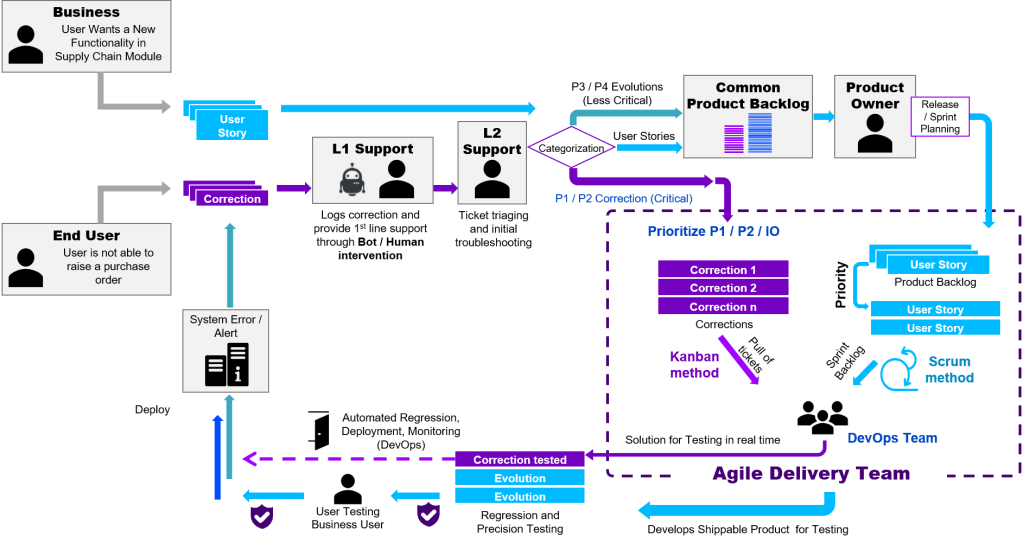
DevOps team – I spend a lot of time this year creating solutions with DevOps teams that are as self-contained as feasible. It is surprising that we don’t yet have a common understanding on how to work with a full-stack cross functional team when you have to consider:
- Solution delivery/development that is somewhat plan-able and often based on Scrum
- Work with the ad-hoc nature of operations tasks based on Kanban
- The work that is more platform related like infrastructure, CI/CD, middleware, integration
- Transformational work or work to reduce technical debt
Getting the balance right between all these things within a team or to split it out to multiple teams has been a fascinating discussion with my clients this year. I am very much looking forward to see this at large scale in 2020. Last year this idea really became mainstream and more and more clients asked for this type of delivery – finally ;-). Here is a simple systematic picture of the associated flow of work:
DevSecOps – For me security was always included in DevOps, but boy did I underestimate the magnitude of this. In 2019 I spoke to nearly all my clients about security and the new challenges in this space. I spoke a lot with security experts in the industry and learned so much more about what is happening in this sapce. I already had an appreciation for the need to secure your applications and your infrastructure (including the DevOps tools) but learning about the magnitude with which DevOps maturity increases the consumption of open source components and the speed of consumption blew my mind. Also the new thread vectors of people placing malicious code on purpose in open source components was something I hadn’t considered before. I for one will make sure all my solutions treat security as a primary concern.
Digital Decoupling – Last but not least the idea of digital decoupling. With the new IT landscapes many organisations are faced with the challenge of becoming less reliant on Mainframes and finding ways to reconfigure their packaged software ecosystems in better ways. Data has become the new answer on how to decouple systems. Being able to work on the data layer instead of having to rely on APIs, ESBs and the likes has really opened completely new ways to address this problem. The speed and agility with which you can create new functionality in this new architecture pattern is impressive. And by investing in the new stack and growing new architectures in an efficient way we can slowly get rid of the legacy applications over time. All that while creating new functionality. Gone are the days of “like for like” upgrades or technology transformations which take months and years. And of course the new architectures are being build based on Agile and DevOps ways of working enabling our transformation.
All these three trends are not completely new in 2019 but are now well and truly center stage. I will continue in 2020 to progress them with my clients and am looking forward to share with you what I learn. A super exciting year lies ahead to fully reap the benefits of these three trends coming together.
A personal note from my side on 2019, as it was an amazing year professionally for me:
The year 2019 started with my book “DevOps for the Modern Enterprise” winning the best DevOps book of the year award and ended with my nomination for “Best DevOps practitioner”. What an amazing year. I look forward to 2020 and how I can help my clients best this year. I have a feeling that this year I will spend more time with a smaller number of organisations and get into a lot more day-to-day details. I am looking forward to that! Nothing is more motivating to me than to achieve results and see an organisation make progress towards better delivery of software-based solutions. And yes getting my hands dirty with the messiness of “heritage” a.k.a. legacy technologies 😉
I hope to meet many of you at a conference or at work to discuss our experiences and share what we have learned in our journeys so far.
Have an amazing 2020 everyone!


 I am trying something new with this blog post – providing a mix of book review and a summary of what I learned about a book I really like. Waiting for Mark Schwartz to release his latest book “War and Peace and IT” I thought I re-read his earlier works. And as I was reading “The Art of Business Value” again I noticed that I am reading it with fresh eyes and that I appreciate this book even more than a few years ago.
 There are obviously a few things different with this transformation and the most obvious yet confusing thing is that there is no end-state. There is no end-state technology architecture, there is no end-state organisational structure and there is no end-state delivery methodology. But if there is no end-state how do we know when we are done? This is the bad news, we will never be done. We have to create capabilities that make it easier and easier to adapt incrementally and we need mechanisms to guide each improvement even in the absence of an end-state.
 I have been a technology architect for a long time and have worked with many different technologies. And there is something satisfying about coming up with “the architecture solution” for a business problem. The ideal end-state that once implemented will be perfect.
 Its already over again – the annual get together of the brightest DevOps minds (well the brightest who could make it to Vegas). And in this instance I want to make sure that what happens in Vegas, does not stay in Vegas by sharing my highlights with all of you. It was a great event with a slightly higher focus on operations than last time.


 A few weeks ago I was in group of people and someone made a statement that application management (AM) is commodity and most people in the group agreed. I didn’t say anything but I think application management is one of the most exciting places to be today. There are so many technology trends that apply to AM: Agile, DevOps, Artificial intelligence, etc.
 Not A Factory Anymore