Tag Archives: Leadership

Why Your Status Report Only Tells Half the Story (and Usually the Nicer Half)

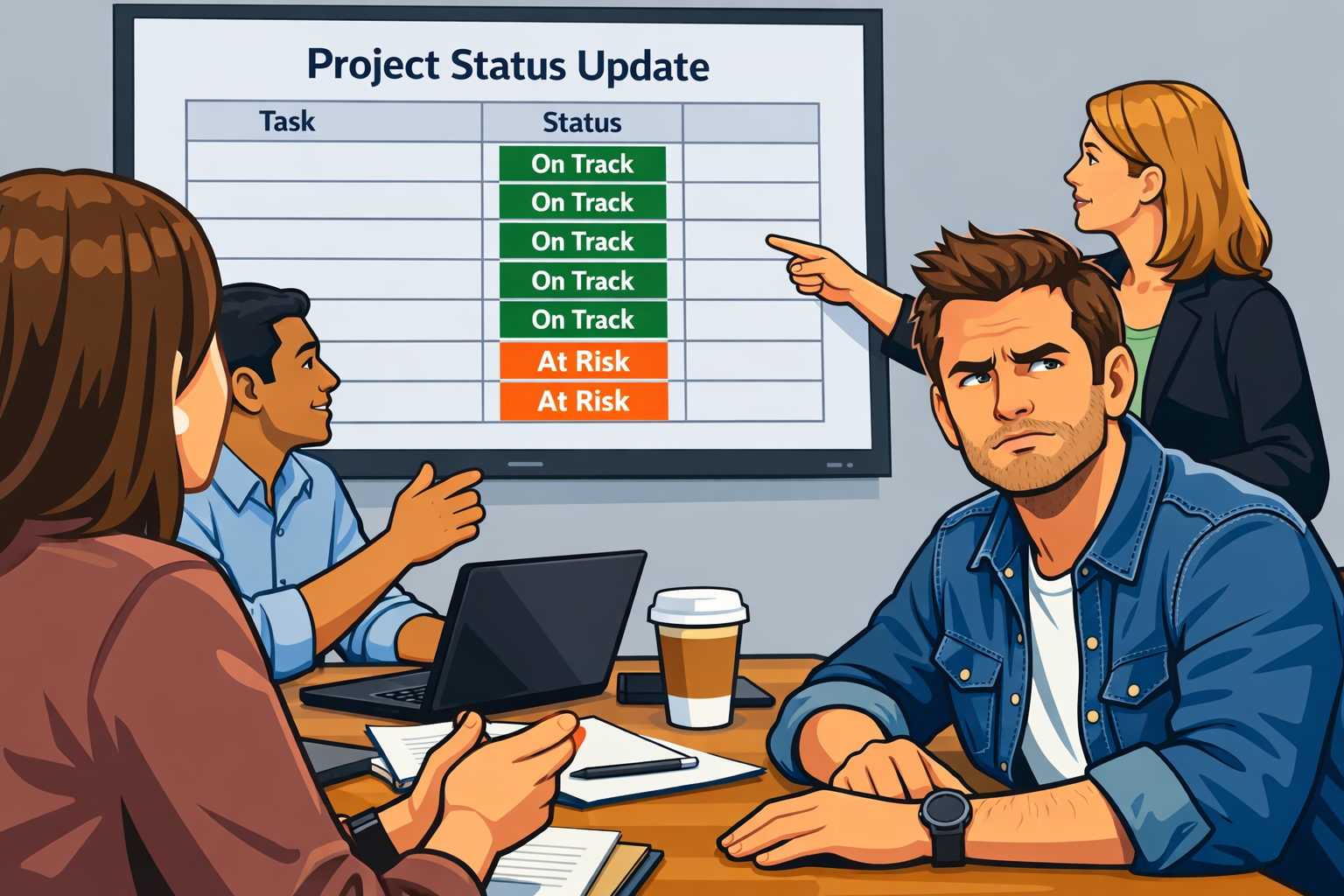
The other day I was in one of those long status review meetings that everyone pretends is productive. Everybody was saying sensible things and somehow we were still heading for trouble. The risk register was full. The status report was mostly green, with a tasteful amount of amber and a bit of red to signal realism.

What struck me wasn’t that the team had ignored risk. Quite the opposite. They had probabilities, impact scores, owners, dates. The mechanics were all there. But when I asked the simple question — what is the overall risk position of this program? — nobody could really answer it. We had plenty of detail, but very little clarity.

I have spent most of my professional life on large delivery and transformation programs, and one thing has changed quite a lot in how I think about status. Early on, I mostly looked at progress against tasks (and I still do as people who have worked for me can painfully attest to given the level of detail I ask for). These days I care far more about outcome measures and risk.

Of course the world has changed too. When I started, everything was waterfall and on-premise. Now it is Agile, cloud, digital and AI. But the bigger shift in mindset for me is this: on complex programs, progress reporting on its own just does not tell you enough to be successful.

I have written before about measures and scorecards, so I won’t go back over that here. What I want to focus on in this post is one lens I ask my teams to include in status reporting: major risk burndown, paired with our contingency position regarding the portfolio risks.

Burn down the most concerning risks early

I still like detailed reporting on deliverables and milestones. But on complex programs that is only part of the picture. What I really want to know is this: what are the few things that could seriously derail us, and what are we doing to reduce that exposure?

One thing I have learned, repeatedly and occasionally the hard way, is that large programs rarely fail because one team missed a task on a plan. They fail at the connection points: dependencies, handoffs, integration points, environments, external parties.

The good news is that many of these failure points are visible early. And once you can see them, you can define the activities that will actually burn that risk down.

In my experience, the usual suspects are not that mysterious. They tend to look something like this:

  • standing up new environments or cloud landing zones
  • third-party delivery dependencies
  • data complexity or sheer data volume
  • system performance
  • integration across systems

There are different ways to identify these risk areas up front. One technique I like is the pre-mortem, popularised by Gary Klein: assume the program has gone badly wrong, then work backwards and ask why.

Once you know the major risks, the next step is straightforward. For each one, define the concrete actions that reduce either its likelihood or its impact. As those actions complete, the risk comes down. That gives you something far more useful than generic “red amber green” commentary: a visible burn-down of uncertainty that you can quantify.

Take a simple example. Say one of your biggest risks is that a third-party system will not integrate properly once delivered. The team assesses that as 25% of the program’s major risk exposure.

You then break the burn-down into concrete steps: agreed interface specification, test stubs, first code drop, functional test pass, performance test pass. If you weight those evenly, each completed step burns down one fifth of that risk. In this example, that means each one reduces overall major risk exposure by 5%.

It does not need to be overly precise or scientific to be useful. It just needs to be explicit enough that the team can see whether uncertainty is actually coming down.

If you are worried about how precise those percentages are, I would not get too hung up on it. In my experience, relative weighting is usually enough. I have used the rough equivalent of planning poker for this: get individual views from the team, compare the outliers, then talk it through until you reach a workable level of consensus. You are not trying to produce actuarial science here. You are trying to make uncertainty visible enough to manage.

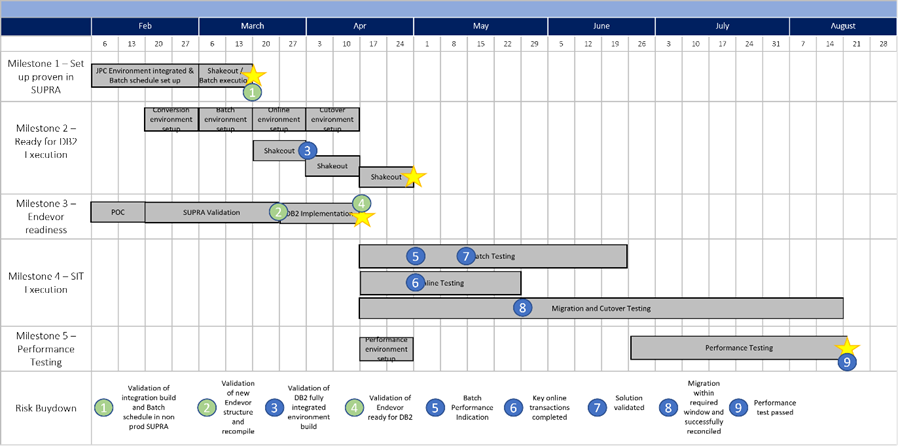
Here is an example schedule for one of the major risks in one of my programs, you can see the 9 burndown actions as little circles. Each would have specific acceptance criteria and a way to measure progress towards it.

This is also one of the things I have always liked most about Agile, at least when people practice it rather than just put it on slides: do the risky thing first.

If something might derail the program, why would you leave it until later? Why would you optimise for neat sequencing when the real problem is uncertainty?

Yet enterprises still do this all the time. We reward predictability over adaptability. We like getting “runs on the board.” We often prefer the appearance of commitment over the economics of resilience.

So if you are betting on something important — a new technology, a big AI-driven productivity gain, a performance improvement, a vendor promise — find a way to test that early. Pull the uncertainty forward. Do not wait politely for reality to reveal itself on your most expensive critical path.

Contingency is how you fund the remaining uncertainty

Major risk burndown is only half the picture. Most programs also carry a long tail of smaller risks: things that are annoying, expensive, and real, but not individually catastrophic.

For those, I find it useful to assign contingency values. In other words: if this risk materialises, what would it likely cost us in money, time or both? That gives you a portfolio view of exposure, not just a list of isolated issues.

Not all risks deserve the same treatment. Some need to be actively burned down because, if they hit, the whole plan changes shape. Others are better handled through contingency: extra money, extra time, extra help, or a workaround.

And of course, if the total value of all identified risks comes to 10 million dollars, it rarely makes sense to hold the full 10 million in contingency. Not every risk will materialise. So organisations make a judgment based on risk appetite, delivery context and portfolio profile. In my experience, holding somewhere between 25% and 75% of the total quantified exposure can be entirely reasonable.

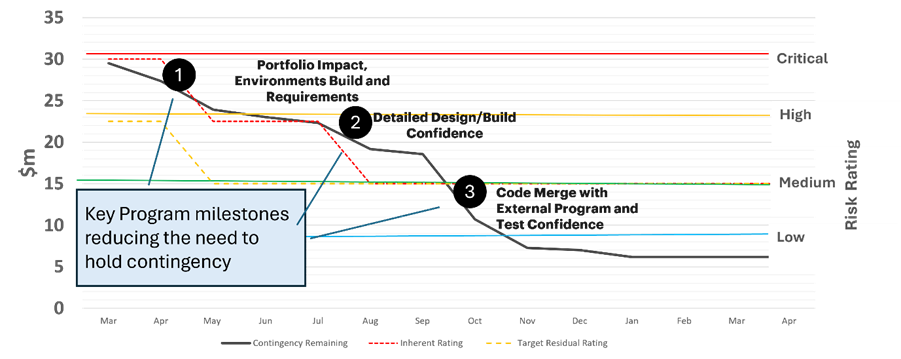
Once you have decided how you will calculate contingency, there are really two disciplines to maintain. First, track the individual risks in the normal way. Second, use major project milestones to reassess how much contingency you still need. As uncertainty comes down, the contingency position should change too.

You can see below what this can look like for a project with 30M contingency:

I am increasingly convinced that one of the best indicators of delivery maturity is not how well a team identifies risks, but how honestly it funds uncertainty and tracks progress against it.

We still too often treat contingency as a sign of weak planning. I think the opposite is usually true. Very often it is a sign that somebody understands the shape of complex work.

There is a lot more to say about contingency management and maintaining optionality in delivery and I suspect I will come back to it.

But the broad idea here is simple enough. On complex programs, progress reporting is necessary, but it is nowhere near sufficient. I want to know which risks matter most, what we are doing to reduce them, and how we are managing the uncertainty that remains.

Even with all of that in place, programs still go wrong sometimes. I have a few scars to prove that – ask me over a beer or whisky about it. But I would still rather face the risky things early than discover too late that all the tidy progress reports in the world were describing motion rather than control.

DevOps Leadership Culture – Staying Cool When it is Getting Tough

LeadershipFor many organizations, the move to DevOps is more complicated than simply putting Agile methodologies, tools, and techniques into practice—it requires a cultural shift. This is especially true when running into the inevitable roadblocks that occur along the path to disruption. This is when IT leaders must stay the course and have faith in their DevOps vision.

In this post, I would like to talk about how IT leaders can create a culture to enable DevOps to thrive, and what the future of IT organisations might look like if they successfully stay the course.

How DevOps and Agile have evolved over the years

I find that the industry seems to have moved along the same phases of focus as myself (but perhaps that is a case of confirmation bias). Let me describe what I mean. Coming from some form of waterfall development and in a time when the best answer to productivity improvement was going offshore or using packaged software, Agile provided an alternative way to deliver projects successfully. The initial focus was on small teams of highly focused individuals and the success of those teams showed what is possible. Early successes meant that many more organizations wanted to adopt Agile and so it was adopted for larger and more complex environments.

At this stage, Agile projects got into trouble as the relatively simple recipes and the tendency toward offshoring and packaged software worked against the ideal of small, co-located teams for Agile delivery. This is where I saw the next two trends picking up: Scaled Agile Frameworks (like SAFe) and DevOps with its cultural and technical aspects. While there is a lot more to be done in this space, I can already see the broader organizational change as the next frontier. Otherwise successful Agile/DevOps teams run into problems with the funding cycles and other organizational practices at the moment. While Agile and DevOps was used in small pockets of organizations, it was easy to fly under the radar; with mainstream adoption we will now have to solve these other, more complex problems in the organization and do so while shifting the overall organizational culture.

Cultural transformation needed to become truly Agile and adopt DevOps: What IT leaders need to do

Over time I came to realize that methodology and technical practices can only get you so far. Staying the course in tough times is not easy and reality is that it’s likely going to get worse before it gets better. Leaders need to believe in their mission and support the team in times when it does not look like there will be quick wins.

There is this story about Toyota and how they introduced a cord in their factories overseas. This cord is pulled whenever there is a problem with the production system. Of course this is disruptive at first and some factories stopped using the cord because of the disruption. The ones who used it had a negative impact on productivity initially while the others continued to produce the same results as before. Management could have easily given up on the cord, but they stuck with it and over time improved their production system so much that they outperformed the other factories significantly. There was no chance for the other factories to catch up afterwards as the improvements were systematic and not just focused on fixing defects as they appeared as the other factories had done. To me this serves as a worthwhile example for management who adopts DevOps. Management needs to find ways to measure progress of the improvements and need to stay the course of systematic improvements even when productivity takes an initial hit. I have seen many transformational efforts that start well and then get stuck when disruption is necessary, which might mean some steps backwards in some regards. Here is where management can show what it means to support a vision and to stay the course. The ones who do and have the right vision will win this race.

Let me share one more piece of personal advice on cultural change. I subscribe to Dan Pink’s sources of motivation at work: autonomy, mastery and purpose. Management should look for opportunities to create a workspace where each team member can increase their satisfaction along those three dimensions. We are all knowledgeable workers in IT, and the best way to get the best out of us is for us to be highly motivated and work in line with the company vision. From talking to people in the IT industry, I often find that we have optimized work in a way that has not considered the relevant characteristics of knowledge workers, and this is likely to be the next area that will increase productivity significantly if addressed correctly.

A look at the Lean Enterprise of the future

Honestly, I think Agile and DevOps will be part of every organization in the next few years. So far, very few have really transformed their whole organization to become as lean as possible. After all, Agile and DevOps are both ways to become leaner. I think that Agile and DevOps practitioners and change agents will join forces with organizational change management practitioners to examine organizational processes. While I don’t know how the end-state looks like in detail, I have a few things in mind that I hope to see in organizations over the next few years, and I will hopefully play my part in some of those transformations. Here is what the organization of the future looks like to me:

  • HR practices have been transformed to recognize the team-based nature of work and that outcomes of the organization matter the most.
  • Financial governance has found a way to decouple funding cycles so that Agile teams can continue working as long as certain organizational results (financial and otherwise) are achieved by teams.
  • Project-based teams are a thing of the past. Teams exist as persistent entities with stable members that transcend traditional role definitions and even organizational boundaries where vendors and system integrators are involved.
  • Stakeholders across the organization have access to real-time information from both business and IT systems to steer the organization.

This post has been adopted from an interview I gave “The Enterprisers” project in the lead up to the DevOps Enterprise Summit 2015 – you can find the full interview here: https://enterprisersproject.com/article/2015/10/creating-culture-devops-thrive

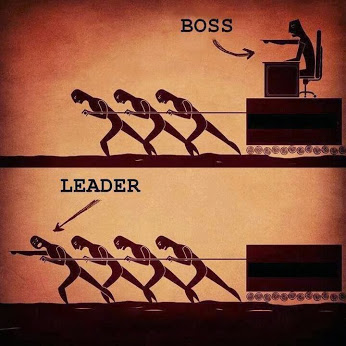
Picture: Leadership vs management by Olivier Carré-Delisle
Taken from Flickr under Creative Commons license