DevOps and Agile transformations continue to be challenging for organisations due to the complexity of the problem. It seems that most people agree on what good looks like but struggle to find their way there. Successful organisations like Netflix or Spotify provide examples but their journey cannot be simply copied and organisations which try encounter a lot of challenges as their context organisationally and technology-wise is different. The transformation is different for every organisation, but some patterns are common, so what can one do.
In my book “DevOps for the Modern Enterprise” I tried to write down my experience from working with many large organisations. While there is no one solution, certain patterns that prove successful can be seen and more importantly a certain way of thinking has been common for organisations who made progress. And of course I have been part of many things that did not work out and can share those experiences too to help others avoid costly mistakes. No need to pay for those lessons yourself.
Three themes run throughout the book:
- The transition from managing IT work similar to manufacturing work towards managing a creative process enabled by knowledge workers
- Dan Pink’s three ways to motivate knowledge workers: Autonomy, Mastery & Purpose
- The power of small batches – why it is important to work in small batches and how to enable them
These three themes run like threads throughout all parts of the book. I was motivated by the fact that as a developer myself, I found it very frustrating how for a period of time over-industrialisation created a view of IT work as just a production process that should be optimised for cost and productivity. Something that simply is not appropriate in this day and age.
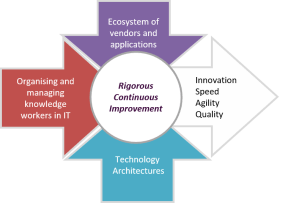
The book is structured in three dimensions of change which need to be addressed for a transformation to be successful:
- The ecosystem of the organisations including vendors and software partners
- The People Dimension and the organisational structure
- The Technology Architecture of practices and technologies to enable engineering
And in the center of it all is a rigorous continuous improvement process that leverages the scientific method to plan and evaluate the experiments that make up the transformation over time.
Let me give a little summary of each section:
Creating the right ecosystem
The ecosystem is the environment in which the transformation needs to take hold to make real change. This part of the book looks at how to setup the transformation for success and how to identify the right applications in a legacy environment that should be tackled first. It also explores the roles of technology vendors and systems integrators and helps organisations choose the right ones that can help during the transformation.
The People and Organisational Dimension
Nothing happens without people in technology, so how can we structure our processes and our organisation in a way that maximises Autonomy, Purpose and Mastery for our knowledge workers?
I explore how Agile helps to provide all three things to our people, how some organisational structures have shown to be good stepping stones for success and how the organisation has to move from testing to quality engineering. I also provide some ideas on how to focus more on the people in the team when managing teams based on my own experience of managing teams.
Technology and Architecture Aspects
The last part of the book is the most obvious one that many expect from a DevOps book. What technologies and technical practices should you use and how can you be successful with them. I revisit Continuous Delivery and more advanced delivery patterns. I take a long hard look at the DevOps tools out there and how you can choose the most suitable ones for your organisation while avoiding any specific vendor recommendations as they would age way too quickly. Of course architecture evolution towards Microservices and leveraging the cloud successfully are covered as well.
Organisations who consider all three dimensions are stacking their chances for success. Each chapter of the book comes with practical exercises that I run with clients and that the reader can run for her/himself in her or his organisation. I wanted to make sure that the book is not just for reading but also for taking action and taking the next step of the journey.
DevOps for the Modern Enterprise is widely available from 4 April 2018:

 I like it simple. And I have a somewhat shaky relationship with maturity models as might have gathered from some of my other
  I guess it is time to get back to work. This week I will shift my focus away from teaching my son how to build block towers, how to not kill himself while climbing on and falling off furniture and other required survival skills. I will go back into the complex and exciting world of Agile and DevOps, but before I do this I wanted to share what my paternity time meant for me.
 When I saw a physical copy of the book for the first time in the morning, it was an unreal feeling. There was certainly pride but also a level of disbelief. But damn does it look good 😉 I went on to an interview with Alan Shimmel (which you can find


 Happy New year to you all. I am now half-way through my paternity leave and I will have to admit that the “Father of the year” award might be slightly out of reach for me this year. I will get to that, but first let me tell you that I will write to the government and make it clear that this should not be called paternity leave. It is paternity work. I have so much respect for all those full-time parents, your day is fully organised by eating, putting little one to bed, cleaning up, making food, changing baby,… I am keeping up with the schedule but will admit that my wife sent me some handy SMS reminders during the day in the beginning. And then you need to use the few free moments to get the basics done: Shower, eat, check on the Ashes and soccer results,…
 After writing about behaviours that help new joiners to be successful I finally got around to write about managers. What does a successful manager look like. And here I don’t mean specific practices like the ones you can learn from
  The good news first: our little one is still alive 😉 All the abstract talk about being a full-time dad has now become my reality. We do not have family around us here as our families live in Sri Lanka and Germany respectively, so there is not a lot of help available. I have been pretty hands-on before as well, getting the little man to sleep, making him food and feeding him and of course changing lots of, let’s say smelly, diapers. But that has been nothing in comparison with being a full time dad.
 time meeting many of my colleagues and looking around the modern office. Of course his daily routine got disrupted by our little adventure. So far I am enjoying the experience and the world at work is not coming to an end. It was a slow letting go of work as I spoke to someone at work every day. Next week I will hear less from work I think. Let’s see. The weather is certainly incentivising me to spend more time outside in parks and cafes, that’s a performance objective I am happy to work on…
 Not A Factory Anymore