Category Archives: Uncategorized

How to support Multi-Speed IT with DevOps and Agile

These days a lot of organisations talk about Multi-Speed IT, so I thought I’d share my thoughts on this. I think the concept has been around for a while but now there is a nice label to associate this idea. Let’s start by looking at why Multi-Speed IT is important. The idea is best illustrated by a picture of two interlocking gears of different sizes and by using a simple example to explain the concept.

The smaller gear moves much faster than the larger one, but where the two gears interlock they gearsremain aligned to not stop the motion. But what does this mean in reality? Think about a banking app on your mobile. Your bank might update the app on a weekly basis with new functionality like reporting and/or improved user interface. That is a reasonable fast release cycle. The mainframe system that sits in the background and provides the mobile app with your account balance and transaction details does not have to change at the same speed. In fact it might only have to provide a new service for the mobile app once every quarter. Nonetheless the changes between those two systems need to align when new functionality is rolled out. However, it doesn’t mean both systems need to release at the same speed. In general, the customer facing systems are the fast applications (Systems of Engagement, Digital) and the slower ones are the Systems of Record or backend systems. The release cycles should take this into consideration.

So how do you get ready for the Multi-Speed IT Delivery Model?

  • Release Strategy (Agile) – Identify functionality that requires changes in multiple systems and ones that can be done in isolation. If you follow an Agile approach, you can align every n-th release for releasing functionality that is aligned while the releases in between can deliver isolated changes for the fast moving applications.
  • Application Architecture – Use versioned interface agreements so that you can decouple the gears (read applications) temporarily. This means you can release a new version of a backend system or a front-end system without impacting current functionality of the other. Once the other system catches up, new functionality becomes available across the system. This allows you to keep to your individual release schedule, which in turn means delivery is a lot less complex and interdependent. In the picture I used above, think of this as the clutch that temporarily disengages the gears.
  • Technical Practices and Tools (DevOps) – If the application architecture decoupling is the clutch, then the technical practices and tools are the grease. This is where DevOps comes into the picture. The whole idea of the Multi-Speed IT is to make the delivery of functionality less interdependent. On the flip side, you need to spend more effort on getting the right practices and tools in place to support this. For example you want to make sure that you can quickly test the different interface versions with automated testing, you need to have good version control to make sure you have in place the right components for each application, you also want to make sure you can manage your codeline very well through abstractions and branching where required. And the basics of configuration management, packaging and deployment will become even more important as you want to reduce the number of variables you have to deal with in your environments. You better remove those variables introduced through manual steps by having these processes completely automated.
  • Testing strategies – Given that you are now dealing with multiple versions of components being in the environment at the same time, you have to rethink your testing strategies. The rules of combinatorics make it very clear that it only takes a few different variables before it becomes unmanageable to test all permutations. So we need to think about different testing strategies that focus on valid permutations and risk profiles. After all, functionality that is not yet live requires less testing than the ones that will go live next.

The above points cover the technical aspects but to get there you will also have to solve some of the organisational challenges. Let me just highlight 3 of them here:

  • Partnership with delivery partners – It will be important to choose your partners wisely. Perhaps it helps to think of your partner ecosystem in three categories: Innovators (the ones who work with you in innovative spaces and with new technologies), Workhorses (the ones who support your core business applications that continue to change) and Commodities (the ones who run legacy applications that don’t require much new functionality and attention). It should be clear that you need to treat them differently in regards to contracts and incentives. I will blog later about the best way to incentivise your workhorses, the area that I see most challenges in.
  • Application Portfolio Management – Of course to find the right partner you first need to understand what your needs are. Look across your application portfolio and determine where your applications sit across the following dimensions: Importance to business, exposure to customers, frequency of change, and volume of change. Based on this you can find the right partner to optimise the outcome for each application.
  • Governance – Last but not least governance in very important. In a multi-speed IT world you will need flexible governance. One size fits all will not be good enough. You will need light-weight system driven governance for your high-speed applications and you can probably afford a more powerpoint/excel driven manual governance for your slower changing applications. If you can run status reports of live systems (like Jira, RTC or TFS) for your fast applications you are another step closer to mastering the multi-speed IT world.

The need for an Onshore Technical Apprenticeship model to counter the falling ladder

This post is a little bit different to my other posts, it highlights a challenge that most of us in the western world is facing, now that offshoring and nearshoring is just a reality of life. I think companies need to think about an onshore technical IT apprenticeship program that allows them to build more technical skills onshore. And it does not matter whether you are a consulting company, an IT shop or a manufacturing business, software is an important part of your business and you better keep building the skills required to run it.

When I started working for my current employer over 10 years ago everyone did some kind of technical work as a new joiner, I personally did some Cobol programming, many of my friends worked with Java. Then as we got more and more senior we had a good understanding of what it takes to develop a solution.

Nowadays if you are trying to staff a technical onshore role, it is actually not easy to find people and often you look to colleagues from offshore centres to help out. A lot of project and program management is still being done onshore and many of the current leaders still come from my generation of “Been there, done that”.
Unfortunately in many IT teams onshore it is today more important to learn exactly 3 technical skills: Excel, Powerpoint and MS Project…

ladderA bit of background:
The problem I describe is what I call the “Falling Ladder” or which in a TED talk was called “sinking skill ladder” (around 10:50 into this video http://www.ted.com/talks/nirmalya_kumar_india_s_invisible_entrepreneurs/transcript?language=en#t-698501) – once you have given all the on the ground technical work to delivery centers, you will soon realise that the people onshore do not have the knowledge to design solutions really well, so you start handing over design as well. Soon you don’t have skills to really project manage anymore as all you can do is manage the spreadsheet, so you hand over project management as well. And then soon all there is onshore is the demand creation either through sales externally or internally. And would you trust a Technical Architect who has never seen code? Okay – this is a slight exaggeration, but you get the gist.
I had a friend who recently left the IT company he was working for and after 2 months of job search we caught up, here is what he said: “It is actually quite hard to find a job if you don’t have any skills beyond excel and MS project, the market is looking for people who understand the technology you are dealing with”. You end up with two choices you get some of the younger guns for the newest set of technologies or someone much older who still has the technical skills of well established technologies, but is that sustainable?

So what should you do:
I think you need to find a way to create the next generation of technical leaders. Technology and specifically software will remain an important part of your business. It is unrealistic to expect to all IT work in-house and onshore, but to really drive technology to the extent that you need to, it is important to retain technical talent. Create some roles in your team that are onshore even if it is unpopular. The investment you make here is small and will pay back easily if you can keep good technical people around and grow them as the next technology leaders in your company.

Picture: The Fall by Celine Nadeau
License: Creative Commons

DevOps for Systems of Record – DevOps Summit Melbourne 21st of November

Update – The DevOps summit has been postponed until early next year.

This time I just want to provide a quick teaser about my upcoming talk at the DevOps summit in Melbourne about DevOps for Systems of Record. I will highlight in this talk my experiences from two case studies, one with Mainframe and one with Siebel and share lessons learned.

IBM_Blue_Gene_P_supercomputerThe talk will highlight four different principles of dealing with Systems of Records in your DevOps adoption:
Principle 1 – Overcoming Culture
Principle 2 – Tenacity over Vendor Advice
Principle 3 – A word about Maturity Models
Principle 4 – DevOps changes everything

After the talk I will provide a more detailed post about the topic, but for now you will have to come over to the Melbourne Convention and Exhibition Centre to hear me speak about it. Check this link for details about the summit: http://www.devops-summit.org/Melbourne

Sure Ways to Fail #1 – No Time for Retrospectives

8226451812_88007f08df_zThis is the first post in a series of posts about anti-patterns that I have seen in my travels. I thought it is helpful for people to understand what is common in projects that fail so that they can learn from others’ mistakes and failures. Over time I will post more and more patterns and I will also post signs of success in a parallel series of blog posts. While these posts are numbered, they will not strictly be in priority order and will rather follow the same pattern as my other posts, which are timely to discussions I have had close to the point of writing the post. Perhaps later I prioritise them, but for now let’s get them on paper.

The number 1 reason I see in teams that fail is that they don’t have effective retrospectives. This can have many reasons, but the most common one I see is that the team does not have time because delivery is taking all their time. They are already working overtime and now they are asked to spend an hour on a retrospective. Clearly that can wait until next iteration. You might ask: how the next iteration will get any better if there is no time to look at what went wrong this time and to improve it. And you are correct. It is likely that the next iteration will end up consuming all the time and there again wont be time for a retro. In my opinion it is not often the case that there is really no time, it’s just a lack of understanding of the importance of the retro and perhaps the experience that previous retro wasn’t effective. One sure way to get teams out of the habit of running retros is when there is no action out of the retro, the team is bringing up all kinds of challenges they had and everyone is happy to pitch in and perhaps actions are also discussed on how to improve things, but then nothing happens. Sometimes the iteration is already committed and there is no room to action anything above and beyond the committed scope. Sometimes the ScrumMaster is not willing to pursue organisational challenges that require escalation and rather waits it out. Sometimes it is simply that no owner was assigned. Whatever it is, if after a couple of retros the team is still highlighting the same challenges and nothing is being done about it, they will question the value and then find it harder and harder to find the time to even do a retro. So perhaps it is not a time problem after all.
I personally like this cartoon, which pretty much sums it all up:
http://listcrown.com/wp-content/uploads/2013/10/busy.jpg

So how do you avoid this sure way to fail:

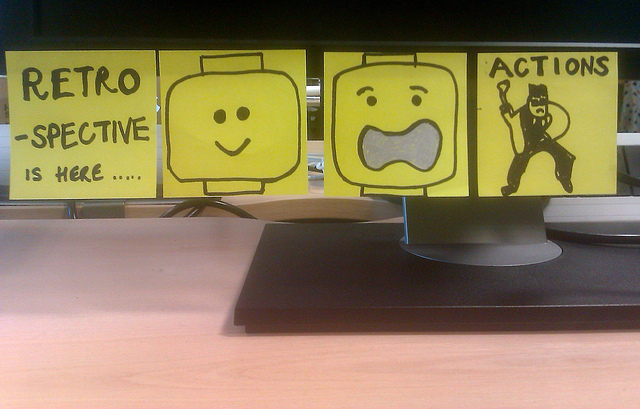
8002453131_7fd9489dfd_zHold regular retrospective – The first remedy is to hold retrospectives regularly and to make sure the team participates. One thing I learned is that there is not one format that works for everyone. You will have to experiment with the team until you find the right duration and activity to get maximum participation. And over time you should mix it up. To put post-it notes under two columns for good and bad can get pretty boring and take away from the value that the retrospectives add to the team.

Follow-up with action – The best retrospective does not help if it is just a session for feedback and then people leave and the system cards and ideas remain in the room. You need to make sure that at least 1-2 actions are taken from each retrospective session and that these actions are visible to the team (ideally on their Kanban wall). If you are the Scrum Master and there have been actions for the organisation that have come up in the retrospective and that the team thinks are important, then you need to make sure that you are accountable for doing something with it. I have attended retrospectives with teams over time and the motivation of the team is proportional to the level of action that comes out of a retrospective.

Bubble up what needs to bubble up – While many actions from the retrospective are internal to the team, there are items that are of interest to the whole organisation and where teams can learn from each other. One risk of the very team focuses ceremonies of Agile is that teams learn but not the organisation. It is therefore that the team and the Scrum Master and any coaches involved make sure that insights from retrospectives are being bubbled up to the organisational level to allow for that exchange of lessons learned and that actions can be taken for things that impact many different teams.

Pictures:
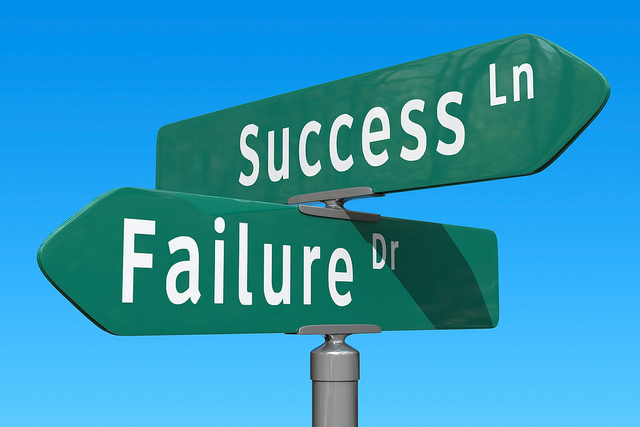
Crossroads: Success or Failure by Chris Potter from www.stockmonkeys.com
License: Creative Commons
Retro-spective is here .. by Paul Downey from https://www.flickr.com/photos/psd/
License: Creative Commons

Welcome to Not A Factory Anymore

Hi everyone,

this is my first blog post. Yes I have finally made the leap into the blogosphere. Over time I will blog here about software delivery, agile, DevOps, Continuous Delivery and anything else that grabs my attention.

But first things first: Why ‘Not a factory anymore’?

I think many of us have heard over time the analogy of Software Delivery with a factory. In my mind that analogy is not accurate anymore and sends the wrong image. Software is not being produced, it is being created, it’s a creative process.

On my blog I will share with you my thoughts on everything that I think shows why the factory model is not appropriate and giving this blog that name leaves no doubt in the reader’s mind, where my allegiance lies in regards to how software based solutions should be delivered.

Looking forward to engage with the community via this blog and to see you around at conferences and meetups