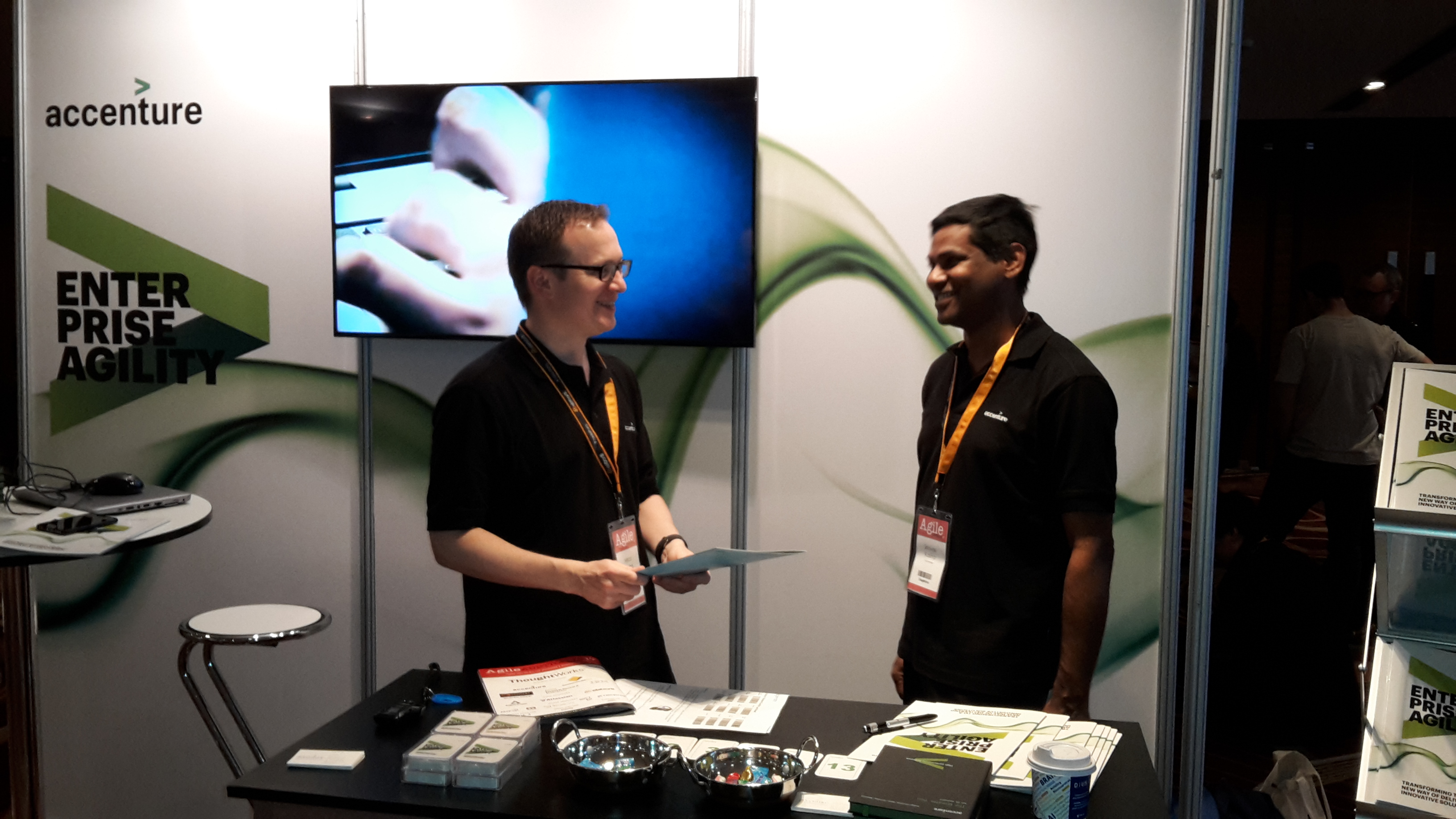
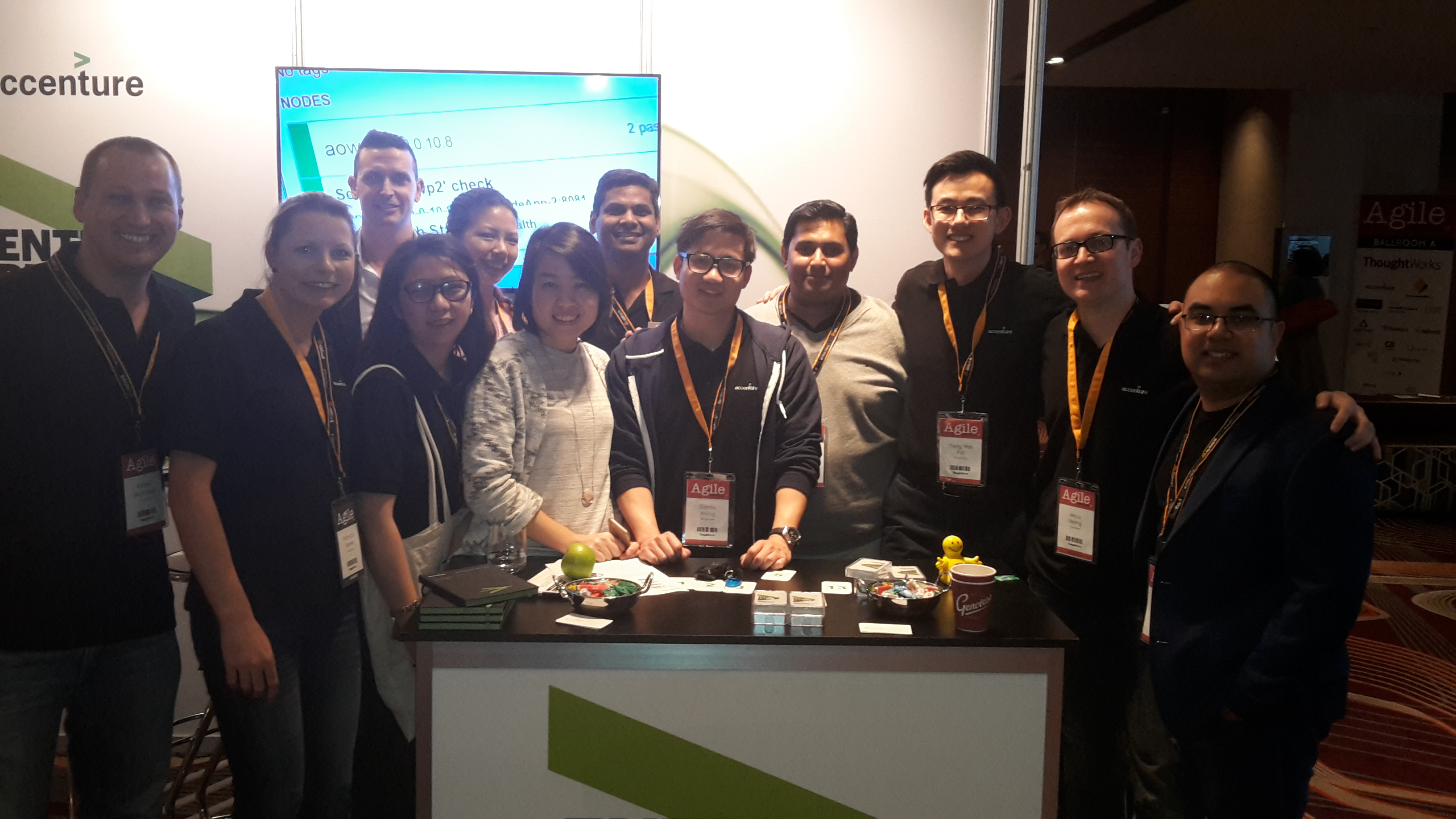
T here it was again the annual gathering of Agilists in Australia – This year in Sydney. The Accenture team turned up in force and we put together a nice little booth as well. Our Planning poker cards were popular with the audience (and of course with our own team too). The booth and the client drinks on the first day gave us the opportunity to talk to people who are adopting Agile in their organisations, many new faces but also many familiar faces who we have been working with for many years. It’s always good to catch-up and get the latest update on someone’s Agile journey. A lot of work goes into organising a conference. A thank you to SlatteryIT for getting a great conference produced each year. Our team put a lot of effort into our part of it, the booth, the presentation and manning the booth. Thanks team!
Of course there were many interesting sessions and choosing the best ones for each time slot proved as difficult as ever – and truth be told, not every session was a winner for me. I will focus on a few really good takeaways from the conference sessions. Of course the most ‘juicy’ information is always exchanged on the ‘hallway track’ – if you go make sure you spend time outside the session rooms talking to people.
Dom Price from Atlassian – He spoke about creating an organisation that enables knowledge workers to do their best work. It was great hearing from someone else about the problem with using factory or manufacturing principles in IT work. During the session I was waiting for the chance to take a photo of his team health framework and then he dropped that it is all freely available online under https://www.atlassian.com/team-playbook Go check it out!
Joshua Arnold on Cost of delay – in the deep dive we talked about uncertainty profiles and what it does for the cost of delay calculation. I found that a very interesting concept and jumped online to learn more. This blog post stood out for me if you want to learn more: http://xprocess.blogspot.hk/2016/04/cost-of-delay-profiles.html
 Barry O’Reilly spoke about the Lean Enterprise – Overall a great and entertaining talk. The one thing that stood out to me was the “delivery gap” which just shows how bad companies are in evaluating themselves – and for that matter how bad people are evaluating themselves ( remember Dunning-Kruger effect).
Sami Honkonen on Responsive Organisations – He had some great examples from his podcast in the talk on why incentives don’t work (the make you focus on the incentive not the work at hand) and why the military is not command and control anymore (something I wrote about here).
Jez Humble – I spoke to Jez after the Deep Dive because he mentioned something I absolutely agree with. Universities are teaching outdated management models. I am very passionate about using the wrong, legacy mental models, something I am speaking about at LAST conference in June 2017 and am writing a book about.
 Near religious wars have been fought over which IT product to choose for a project or business function. Should you use SalesForce, SAP or IBM? I am not a product person, but I have learned over time that just looking at the functionality is not sufficient anymore. It is very unlikely that an organisation will use the product As-Is and the application architecture the product is part of will continue to evolve. The concept of an end-state-architecture is just not valid anymore. Each component needs to be evaluated on the basis of how easy it is to evolve and replace. Which is why architecture and engineering play a much larger role than in the past. This puts a very different view on product choice. Of course the choice is always contextual and for each company and each area of business the decision might be different. What I can do though is to provide a Technology Decision Framework that helps you to think more broadly about technology choices. I wrote about DevOps tooling a while ago and you will see similar thinking in this post.
 If you have been following my blog, you will know that I am disappointed on how little the cultural relationship between companies and their systems integrators is being discussed in blogs, articles and conference talks. As I am working for an SI I find this surprising. Most large organisations work with Sis, so why are we not talking about it? If we are serious about DevOps we should also have a DevOps culture with our SIs, shouldn’t we?


 Not A Factory Anymore